How Big Are Countries Really? Compare Real Sizes Without Map Distortion
Ever wondered the countries look bigger on map are actually small and the countries look smaller on map are actually quite big?
Why does Greenland look bigger than Africa on most maps? Is Russia really that massive, or is the map lying to us? And how on earth does a tiny-looking country like Brazil actually span an entire continent?
You've probably stared at a flat world map and felt that something was off — without realizing you were right. Ever felt like your world map was lying to you? It actually is. Because the Earth is a sphere being flattened onto a 2D surface, standard maps use the Mercator projection, which drastically stretches landmasses near the poles while shrinking those near the equator.
Instantly see the real size of any country without the distortion caused by traditional map projections like Mercator. No more guessing — just honest geography.
Application Key Features:
User Guide: Step by Step Guide to Use True Size of Countries Map Application
This guide will help you to use this free application for education purposes.
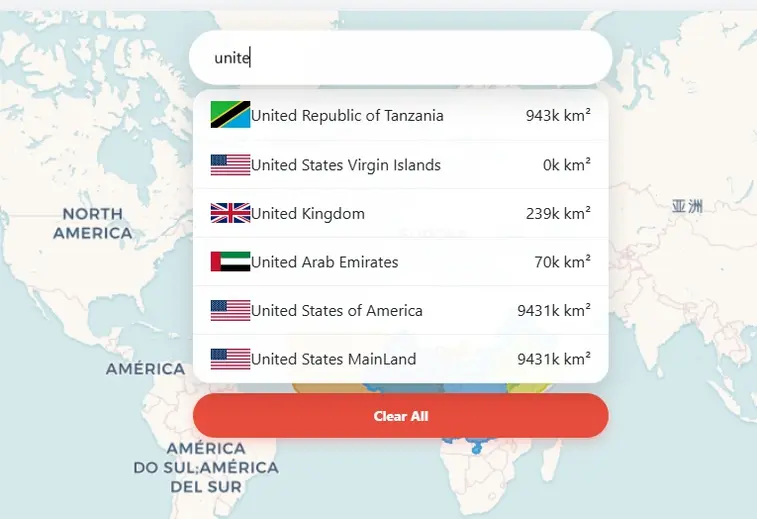
Step 1: Search Country Name
Start typing in search bar. Country names will be suggested in drop down.
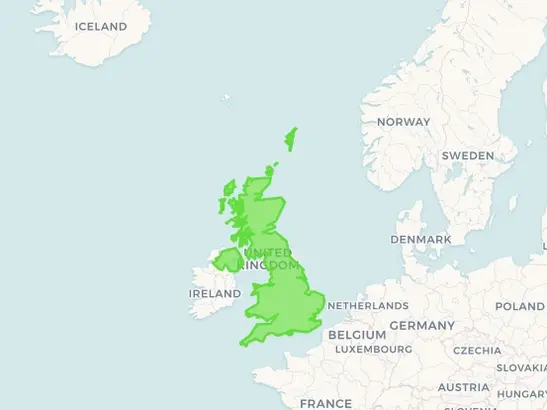
Step 2: Select Country
Select country from the dropdown list and click. Map will show the search country and zoomed to its location.
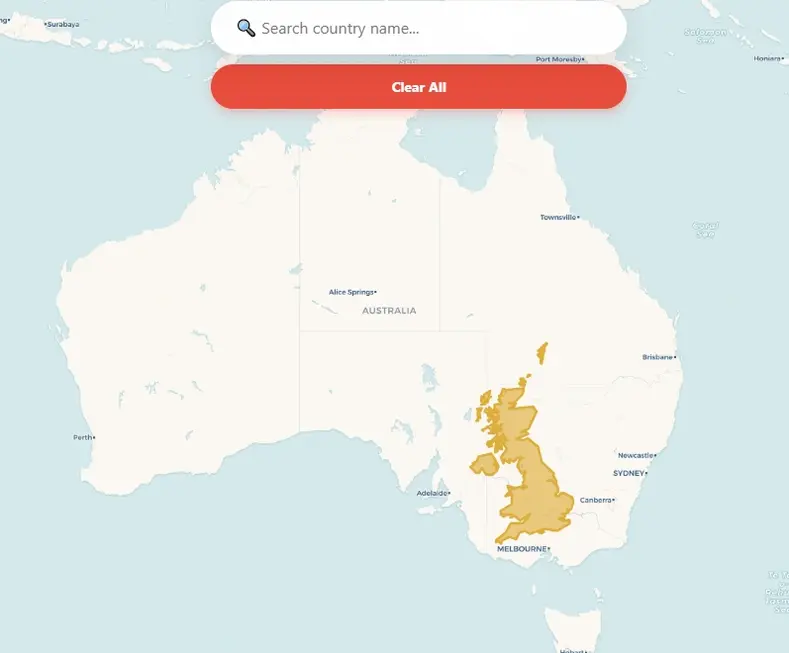
Step 3: Drag Country on Map
Click on the country map and hold. Now you can drag it anywhere on map to compare the size with other countries. While you are dragging it will show the area of country in square km and percentage of map distortion due to projection.
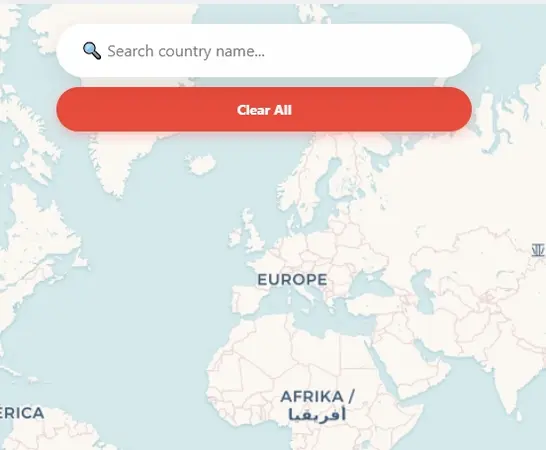
Step 4: Reset Map & Clear the Results
Just press clear button then it will reset the application with blank world map.
For centuries, mapmakers have used projections (like the famous Mercator) that stretch countries near the poles to make them look enormous, while shrinking those near the equator. The result? A world where Europe appears larger than South America (it's not), Alaska looks as big as Mexico (nowhere close), and Antarctica seems to go on forever. But here, on this distortion-free map, you can finally get honest answers. Drag any country, drop it next to another, and see for yourself: the world isn't quite shaped the way you were taught. Prepare to have your mental map — literally — turned upside down.
A Brief History of the Projections
The history of map projections is essentially a 2,000-year-long struggle to solve a single mathematical impossibility: flattening a sphere onto a plane without tearing or stretching it.
The goal was not the creation of the perfect, all-encompassing data format, but the development of a simple, efficient way for geospatial data to be displayed and worked with on the increasingly powerful desktop computers of the era.
The Ancient Roots
Mapping began with the Greeks, who were among the first to acknowledge the Earth as a sphere. Ptolemy (c. 150 AD): In his work Geographia, he developed the first systematic methods for projecting the curved Earth. He used conic projections, where the Earth is projected onto a cone placed over the sphere. This preserved some sense of distance but was limited to the "known world" (the ecumene).
The Age of Navigation: The Mercator Revolution
As global exploration exploded in the 16th century, sailors needed a map they could actually navigate with.
The Quest for Fairness: Equal-Area Maps
By the 19th and 20th centuries, critics argued that the Mercator projection was "Eurocentric" because it made northern colonial powers look much larger than tropical nations. Gall-Peters Projection (1973): James Gall and later Arno Peters promoted an equal-area projection. It sacrifices shape (stretching continents vertically like "hanging laundry") to ensure that every square inch on the map represents the same number of square miles on Earth. Mollweide Projection: An elliptical projection often used for global data (like climate maps) because it balances the entire world's area accurately.
The Modern Compromise: "Reference" Maps
Cartographers eventually realized that you can't have it all—area, shape, and direction can never be perfectly reconciled. Today, most modern atlases use Compromise Projections. Robinson Projection (1963): Used by National Geographic for decades. It doesn't get area or shape perfectly right, but it "looks" right to the human eye by distorting everything just a little bit. Winkel Tripel (1921): Currently the gold standard for many educational organizations. It minimizes the three types of distortion: area, direction, and distance.
The Digital Age: Web Mercator
Ironically, despite all our progress, the Mercator projection made a massive comeback with the internet. Google Maps and OpenStreetMap use "Web Mercator." Why? Because at the local level (zooming into a city block), it preserves 90-degree angles for street intersections. If they used a different projection, your neighborhood would look skewed and tilted as you scrolled around!
Open Source Resources
Map Tools Brief Description
-
Radius Map Online – Measure Radius on Map :
Radius Map Tool is a very simple easy to use web map tool. With the help of this tool, you can draw a circle of your desired radius on map at given location. You can easily move and edit the circle on map by changing its color, radius and location. You can download the map as jpg.
-
Calculate Area on Map Online- Land Area Calculator Map:
Area Calculator on map is a free area map tool. This area calculator tool using web map allows you to find out the area in multiple units that is enclosed inside a closed polyline overlaid on a map. You can also download the data in geojson format.
-
Map Distance Finder - Driving & Straight Distance Between 2 Locations:
Distance Calculator on map is a very intuitive& simple free GIS web tool to calculate distance between two locations. It provides street or driving distance as well as straight distance. You can also download route data in the form of geoJSON to use on any GIS software.
-
Elevation / Altitude Finder By Address or Current Location:
Get your current elevation on map using this free online web map application. Just locate yourself on map and get the altitude of specific point. You will get elevation using 90 meter resolution dataset. It means accuracy of the elevation is approximation under 90×90 meters.
-
Zip Code Lookup by Address - Find a Post Code:
To find a zip code (or postal code) for your current location or a specific address, you can use this free tool to mark your position on map and find postcode on single click. Worldwide postal code finder for any address on map makes your life easier.
-
EV Charger Finder - Find Electric Car Charging Stations on Map:
Nearby EV charging station finder on map within United States and get google maps driving directions. This tool will allow you to search street address to find nearest charging port of required location. You can also enter the coordinates or you can use your current geographic location.
-
What is My Current Time Zone - Time Zone Map:
It provides your current GMT time zone, current local time, address date and coordinates worldwide. You can search your address or can use your GPS location. Retrieved information about the time zone can easily be shared on whatsapp.
-
GPX Data Viewer Online - View Hiking, Cycling, Running Data on Map:
Simple user friendly web mapping application to find time zone on map by simply searching the address, postal code, geographic coordinates. You can also search for current time zone by just click my location on map. Click on map and you will be provided detailed information about your current time zone.
-
Shapefile Viewer Online - View GIS Data in .shp Format:
Want to view your GIS data in Esri Shapefile .shp format on map online? Use our shp viewer free application tool to display your shp file format data online. Map can also be exported using this shapefile viewer online application.
-
GPX to GeoJSON Converter
Do you need to convert your GPS data stored in GPX format to well known GeoJSON data. This free web tool will do this job for you. Just upload data, convert and download the required format.
-
KML Online Viewer - Visualize .kml .kmz Data on Map Online
Web Application to view KML, KMZ files on street map and satellite image. View and explore KML and KMZ files online. Fast, free KML viewer shows your placemarks, paths.
-
Coordinates Plotter - Plot Latitude and Longitude on Map Bulk CSV
This online map application provides you with an interactive map made with your own geographic data in CSV file format.
-
Geotag Photos for Free - Batch Editing
Batch-upload up to 10 photos at once, edit EXIF metadata and geotag each image individually in just a few clicks, then export the updated files as high-quality JPEGs.
-
True Size of Countries
The world as it actually is, not just how it’s drawn. How big is your country? Drag it to find out. True Scale. Real Geography. No Distortions.