What Is the Best Angle for Solar Panels at My Location? Free Calculator
The best angle for solar panels at your location depends mostly on your latitude. A solar panel makes the most power when sunlight hits it straight on. The sun rides high in summer and low in winter, so the ideal tilt changes through the year. This solar panel tilt angle calculator, also called a PV angle calculator (PV means photovoltaic), does the maths for you. Enter your latitude and longitude, or press My Location, and it shows the optimal tilt angle for solar panels in summer, in winter and for the whole year.
Many people search for a "what is the best angle for solar panels at my location calculator". This is that calculator. People also search for "what is the best angle for solar panels at my location free", and the answer is the same: this tool costs nothing, needs no account and runs in your browser. It works as a PV angle calculator app on phones, tablets and computers, with nothing to download or install.
The tool detects your hemisphere. In the Northern Hemisphere the sun stays in the southern half of the sky, so panels should face true south. In the Southern Hemisphere they should face true north. The calculator picks the right side for you and works out every angle for your side of the equator, so you get the solar panel angle by location for any place on Earth.
Behind the numbers is a solar model that treats every month on its own. For each month it works out how much sunlight reaches a tilted panel and then finds the angle that collects the most energy over the period you care about. You get three headline angles, a month-by-month table, charts and a PDF report that you can keep or send to your installer.
Who Can Use This Solar Panel Tilt Angle Calculator?
Home owners planning a roof or ground array, installers who need a quick check, off-grid cabin owners, RV and boat owners, teachers and students all use it. If you can find your latitude, you can use it. The calculator also helps if you already own panels and want to know how much energy a small change of angle would gain or lose. The PV angle calculator app is also handy in a classroom, because it shows how the sun's path changes the best angle month by month. If you do not know your latitude, find it first with the GPS Coordinates Finder.
Key Features
- A free PV angle calculator app that runs in any browser, with nothing to install.
- Use your current location, search an address, click the map or type latitude and longitude.
- The hemisphere is detected automatically and the panel direction is set to true south or true north.
- Optimal tilt angle for the whole year, for summer and for winter.
- A month-by-month table with day length, noon sun height, the best tilt and the energy at your angle.
- Three sky settings (sunny, average, cloudy) so the answer fits your climate.
- The map has no basemap by default. A bold switch turns on street, satellite or terrain when you need it.
- Download a PDF summary with a letterhead and a maplity.com watermark.
- A table of summer, winter and whole-year angles for 100 famous cities in the USA and Europe.
How to Use the Solar Panel Tilt Angle Calculator: Step by Step
The map is plain by default and shows only the equator, the tropics and the polar circles. The bold Show basemap switch above the map turns on street, satellite or terrain tiles. A basemap helps you find your roof or your land. The results are the same with or without it.
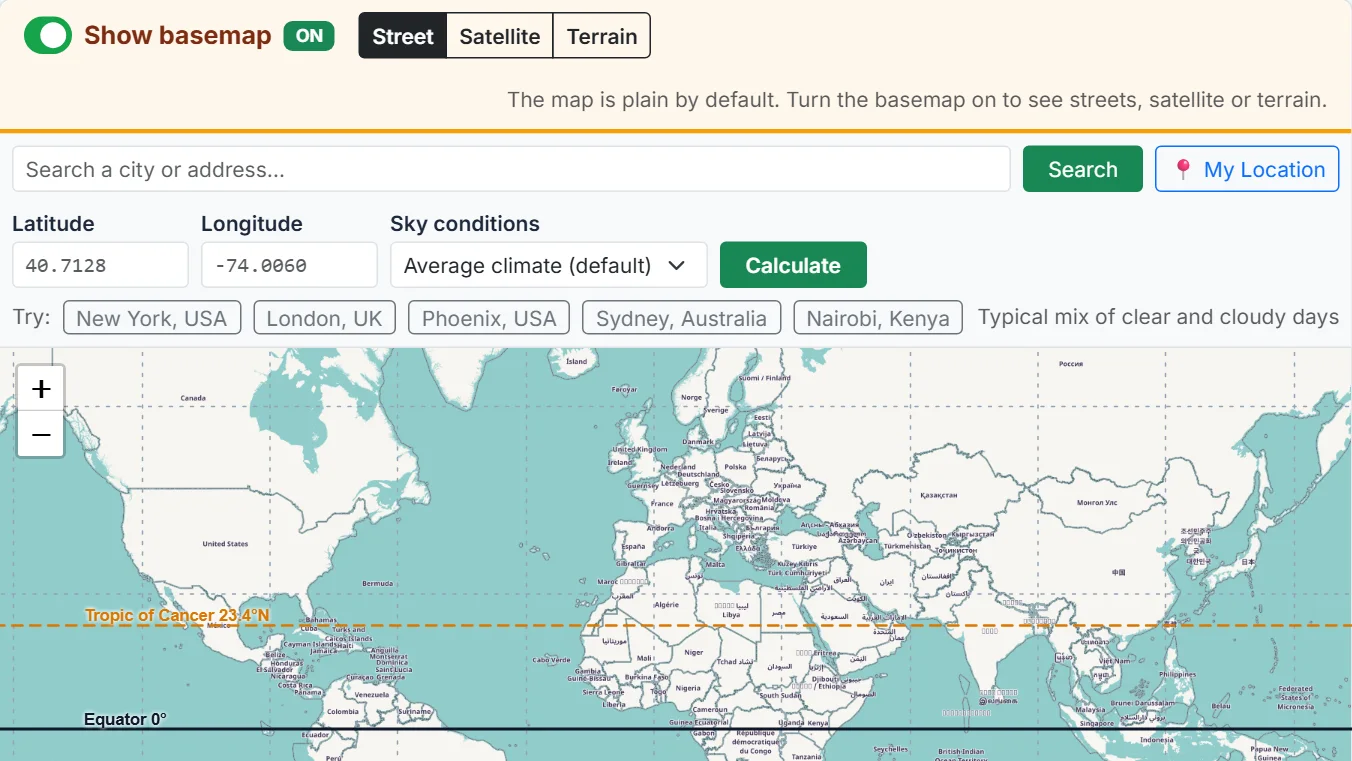
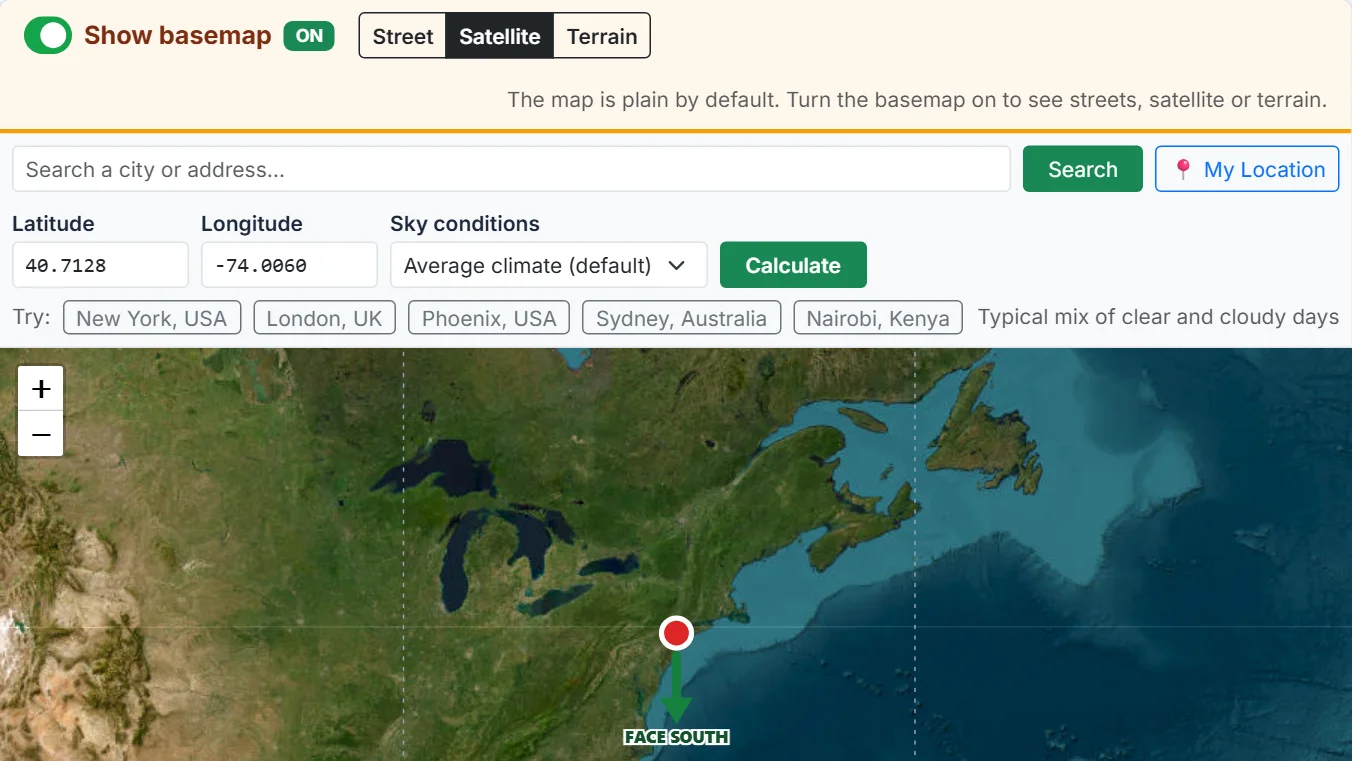
Type a latitude and longitude, search for a city or an address, click the map or press My Location. The red dot marks your site and the green arrow shows which way the panels should face. Then pick sunny, average or cloudy sky conditions and press Calculate.
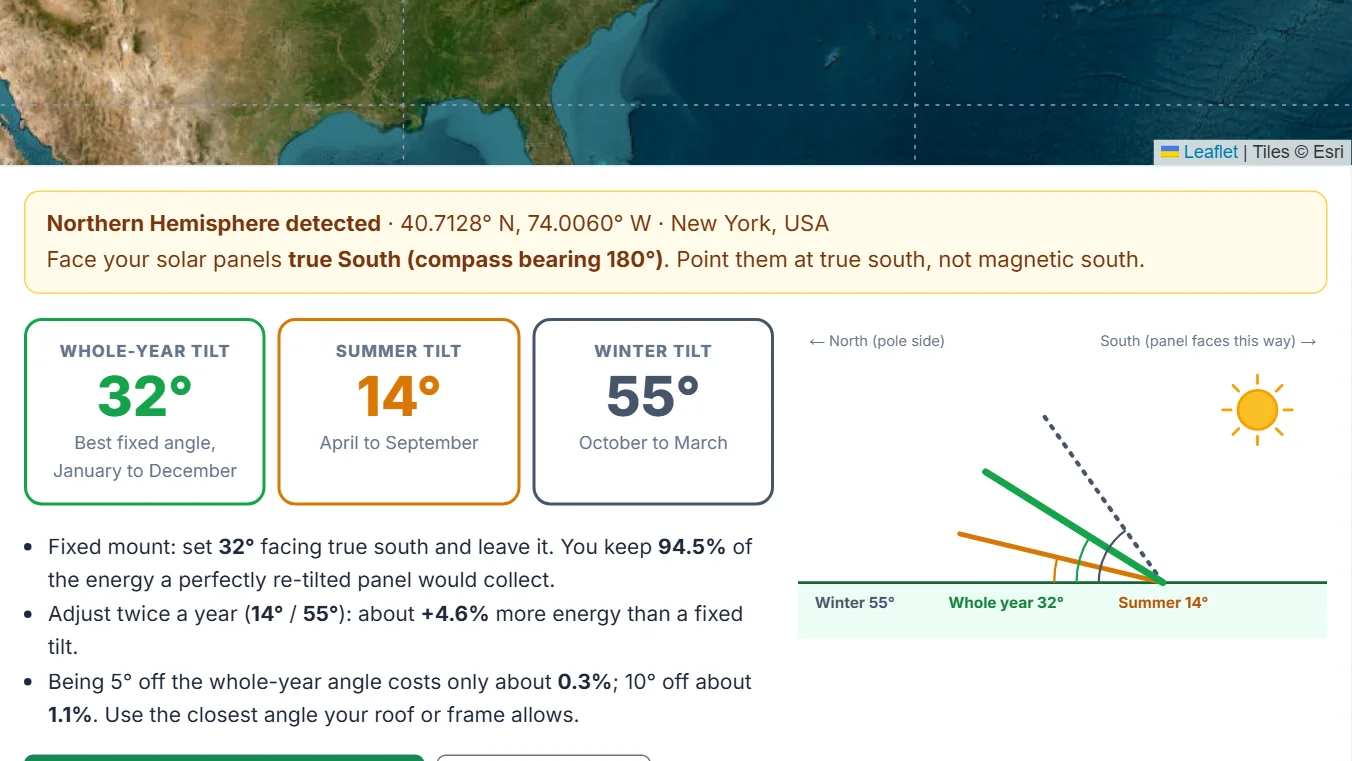
The banner tells you if your site is in the Northern or Southern Hemisphere and gives the direction to face: true south in the north, true north in the south. The three cards show the best angle for the whole year, for summer and for winter.
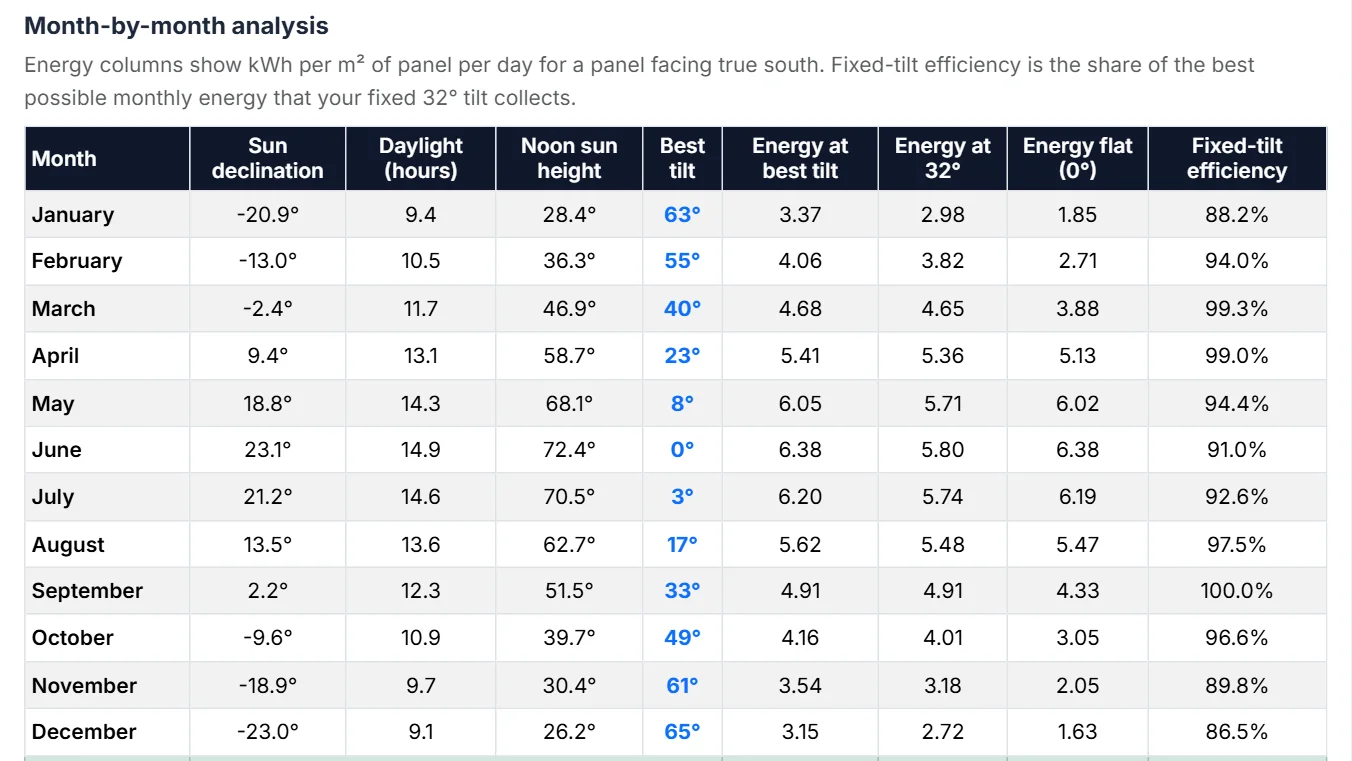
The table lists day length, noon sun height, the best tilt for each month and the energy your fixed tilt collects. The last column shows how close a fixed angle gets to a perfect angle every month.
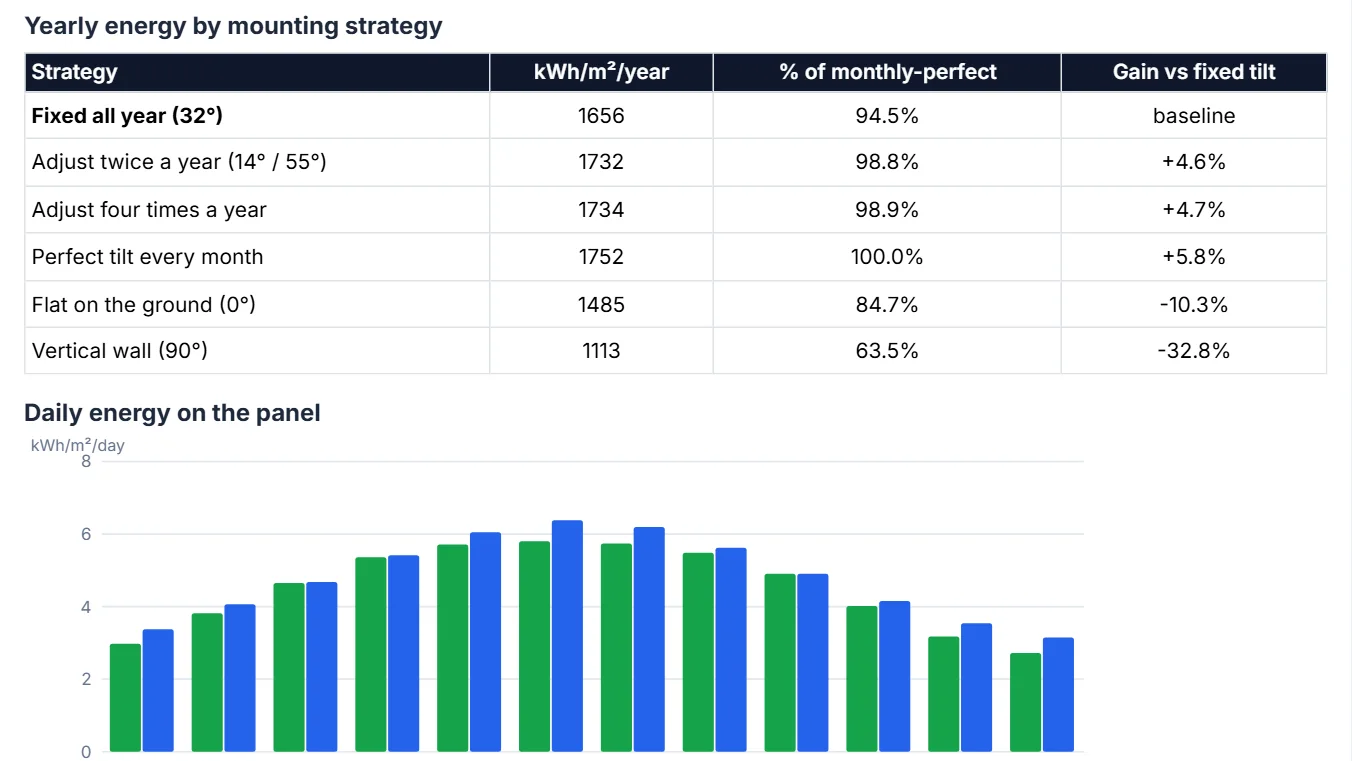
See how much energy you gain by adjusting the tilt twice or four times a year, or by lying flat. The charts show the daily energy and the best angle for each month at a glance.
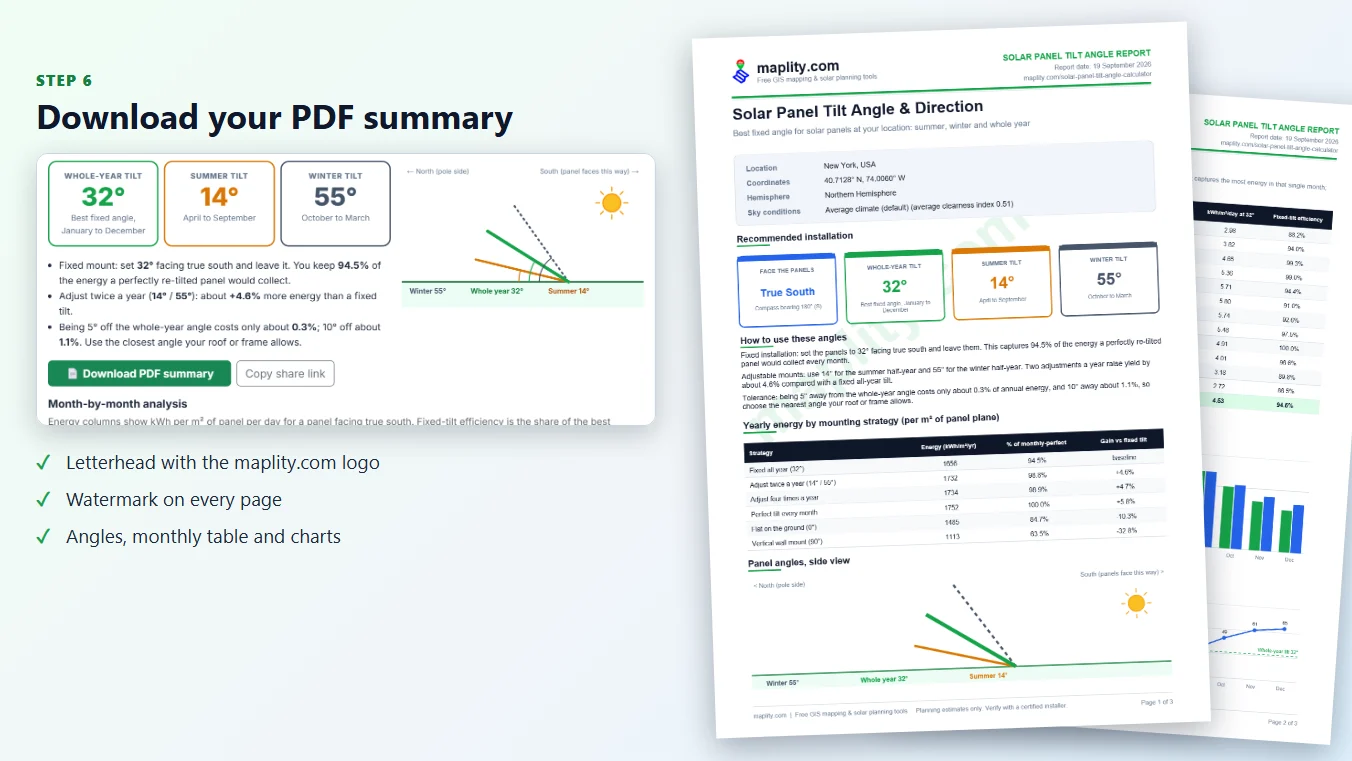
Press Download PDF summary to save a report with a maplity.com letterhead and watermark. It includes your location, the recommended angles, the monthly table and charts. Share it with your installer or keep it for your records.
The Science Behind the Solar Panel Tilt Angle
This section explains why the best tilt changes with your location and the season. You do not need it to use the calculator, but it helps you trust the numbers and adjust them for your own roof.
Why the Angle Matters
Sunlight that hits a panel at a slant spreads over a larger area, so each square centimetre gets less energy. The loss follows the cosine of the angle between the sunlight and a line drawn straight out of the panel. If the sun is 60 degrees away from that line, the panel receives only half of the light it would receive facing the sun directly, because cos 60° = 0.5. The goal of tilting is to keep the sun as close to straight-on as possible, for as many hours and as many months as possible.
How the Sun Moves During the Year
The Earth's axis is tilted by about 23.45 degrees. Because of this, the point on Earth where the sun is directly overhead moves between 23.45°N in June and 23.45°S in December. This angle is called the solar declination. At noon the sun's height above the horizon at latitude φ is:
In New York (latitude 40.7°N) the noon sun reaches about 73 degrees above the horizon in June and only about 26 degrees in December. Days are 14.9 hours long in June and 9.1 hours long in December. Everything about summer and winter angles comes from this swing.
Solar Panel Tilt Angle Formula
These formulas show how to calculate solar panel tilt angle. They are used in installation guides and in this calculator:
- Declination: δ = 23.45° x sin[ 360/365 x (284 + n) ], where n is the day of the year
- Noon tilt for one day: β = |φ - δ|
- Annual rule of thumb: β = 3.7° + 0.69 x |φ|
- Summer rule: β = φ - 15° (middle of summer)
- Winter rule: β = φ + 15° (middle of winter)
Here φ is your latitude in degrees (use the absolute value in the Southern Hemisphere) and β is the tilt from horizontal. The last two rules are for the peak of the season, not for the whole half-year, which is why the half-year angles in the tables below are lower for summer and close to the rule for winter.
How to Calculate Solar Panel Tilt Angle by Hand
- Find your latitude. For New York it is 40.7° N.
- Pick the day. On 21 June the declination is +23.45°, at the equinoxes it is 0°, and on 21 December it is -23.45°.
- Subtract: on 21 June the noon tilt is |40.7 - 23.45| = 17.3°. At the equinoxes it is 40.7°. On 21 December it is |40.7 + 23.45| = 64.2°.
- For a fixed panel, use the annual rule: 3.7 + 0.69 x 40.7 = 31.8°.
- Face the panel true south (true north in the Southern Hemisphere).
The hand method points the panel at the noon sun. It ignores morning and evening sun, day length, the atmosphere and clouds. That is why the calculator above uses a radiation model: for New York it gives 32° for the whole year, which is close to the hand result.
Why This Calculator Uses a Radiation Model
The model follows a standard method from solar engineering textbooks. For each month it does five things:
- It calculates the sunlight above the atmosphere from your latitude and the sun's declination.
- It reduces that light for the path through the atmosphere. Low winter sun crosses more air, so more light is lost.
- It applies your sky setting, which represents how often clouds block the sun in your climate.
- It splits the light into direct sunbeams and diffuse light from the whole sky.
- It adds up the light that reaches a panel at every tilt from 0 to 90 degrees, then picks the tilt with the highest total for the period.
Diffuse light does not depend much on tilt, and clouds increase its share. So cloudy places get lower optimal angles than sunny places at the same latitude.
Solar Panel Tilt Angle Chart by Latitude
This solar panel tilt angle chart shows the optimal angle for panels facing the equator, for an average climate. The last column is the annual rule of thumb from the formula above, so you can compare it with the radiation model. Angles below 10° are shown as 10° so rain can wash the glass. For the Southern Hemisphere use the latitude without its sign, and swap the seasons: summer runs from October to March.
| Latitude | Summer half-year | Whole year | Winter half-year | Annual rule of thumb |
|---|---|---|---|---|
| 0° | 10° | 10° | 20° | 3.7° |
| 5° | 10° | 10° | 24° | 7.2° |
| 10° | 10° | 10° | 28° | 10.6° |
| 15° | 10° | 12° | 32° | 14.1° |
| 20° | 10° | 16° | 37° | 17.5° |
| 25° | 10° | 21° | 41° | 20.9° |
| 30° | 10° | 24° | 46° | 24.4° |
| 35° | 10° | 28° | 50° | 27.8° |
| 40° | 13° | 32° | 54° | 31.3° |
| 45° | 17° | 35° | 58° | 34.8° |
| 50° | 22° | 38° | 62° | 38.2° |
| 55° | 26° | 41° | 66° | 41.6° |
| 60° | 30° | 43° | 70° | 45.1° |
| 65° | 33° | 45° | 74° | 48.5° |
Optimal Tilt Angle for Solar Panels in Summer
Why Summer Angles Are Low
In summer the noon sun is high in the sky, and days are long. At 40°N the sun rises well to the north-east, about 58 degrees east of north, and sets in the north-west. A steep south-facing panel is nearly edge-on to that early and late sun. A flatter panel catches it. Summer light is also a little more direct, but a large part of it is still diffuse, and diffuse light reaches a flat panel from the whole sky.
What the Numbers Say
For the summer half-year (April to September in the north) the calculator gives 13° at 40° latitude and 22° at 50° latitude. That is roughly one third to one half of the latitude. If you only care about the peak of summer, the best month is June, when the best tilt for New York is about 0°, close to flat. The old rule "latitude minus 15 degrees" is a little steep for the whole half-year, but it is a safe choice for a fixed summer tilt.
Practical Tips for Summer
- Do not go below 10 degrees. Flatter panels keep water and dust on the glass.
- Hot panels make less power. Silicon panels lose about 0.3 to 0.4 percent of power for each degree Celsius above 25°C, so leave a gap behind the panel for air.
- In the Southern Hemisphere the summer angle applies from October to March.
- Near the equator the sun is almost overhead, so a small tilt of 10 to 15 degrees works all year.
Best Angle for Solar Panels in Winter
Why Winter Angles Are Steep
In winter the noon sun is low. At 40°N on 21 December it stands only about 26 degrees above the horizon. To face that low sun, the panel must be tilted steeply, close to 64 degrees for the noon sun alone. A steep tilt also reduces the light that bounces off the glass at a shallow angle, and it makes dust and water run off. The best angle for solar panels in winter is usually your latitude plus 10 to 15 degrees.
What the Numbers Say
For the winter half-year (October to March in the north) the calculator gives 54° at 40° latitude and 62° at 50° latitude. In December, the darkest month, the best tilt for New York is about 65°. Winter energy is small even at the best angle, so the gain comes from making a low number a little higher.
Snow, Short Days and Off-Grid Systems
- Snow slides off steep panels. Fresh snow on the ground reflects 60 to 90 percent of the light, and steep panels collect much of it.
- Off-grid systems must survive the worst month. If you run a cabin, a boat or a pump from batteries, choose the winter angle, so the darkest month sets your design.
- Grid-tied homes care about yearly energy, so the whole-year angle is usually better.
- Very steep frames face more wind. Follow the mount maker's limits and your local building code.
How to Optimize Solar Panel Tilt for the Whole Year
Choose One Fixed Angle
A fixed panel needs one angle that works in every season. The calculator finds the angle that maximises the total energy over the year. It is lower than your latitude because summer brings more energy than winter. The curve is flat near the top: for New York, a 5 degree error costs only about 0.3 percent and a 10 degree error about 1.1 percent. Pick the closest angle that your roof or frame allows.
Adjust with the Seasons
The table shows what New York gains from changing the tilt during the year, compared with one fixed angle.
| Strategy | Energy (kWh/m²/year) | Gain vs fixed tilt |
|---|---|---|
| Fixed all year (32°) | 1656 | baseline |
| Twice a year (14° in summer, 55° in winter) | 1732 | +4.6% |
| Four times a year | 1734 | +4.7% |
| Perfect tilt every month | 1752 | +5.8% |
| Flat (0°) | 1485 | -10.3% |
| Vertical (90°) | 1113 | -32.8% |
Two changes a year capture almost all of the possible gain. Four changes add very little. Monthly changes are only worth the work for a research setup or a tracker.
Which Tilt for Which Goal
| Your goal | Best choice |
|---|---|
| Most energy over the year (grid-tied) | Whole-year tilt from the calculator |
| Reliable power in the darkest month (off-grid) | Winter tilt |
| Most energy in summer (air conditioning, pumps) | Summer tilt |
| Adjustable mount, willing to change twice a year | Summer tilt and winter tilt |
| Roof pitch within 10° of the best tilt | Mount flat on the roof |
| Heavy snow area | Winter tilt or steeper |
Which Direction Should Solar Panels Face?
Face the panels toward the equator: true south in the Northern Hemisphere and true north in the Southern Hemisphere. Use true direction, not a compass reading, because magnetic north differs from true north by up to about 20 degrees depending on where you are. As a rough guide, a direction error of 15 degrees costs 1 to 2 percent of yearly energy, 30 degrees costs 3 to 5 percent and 45 degrees costs 8 to 12 percent. An east or west facing roof loses 15 to 20 percent, but it produces more in the morning or in the evening, which can suit homes that use most power at those times.
Solar Panel Angle by Location: Optimal Tilt for 100 Famous Cities in the USA and Europe
These tables give the summer, winter and whole-year optimal tilt angle for solar panels in 50 cities in the USA and 50 cities in Europe. Every value comes from this calculator, using the typical climate of the city. All these cities are in the Northern Hemisphere, so panels face true south. Summer is April to September and winter is October to March. Angles below 10° are shown as 10°. Use the calculator above with your exact coordinates for a precise result.
Solar Panel Tilt Angle in 50 Cities in the USA
| # | City | State | Latitude | Climate | Summer tilt | Winter tilt | Whole-year tilt |
|---|---|---|---|---|---|---|---|
| 1 | New York | NY | 40.71° N | Average | 14° | 55° | 32° |
| 2 | Los Angeles | CA | 34.05° N | Sunny | 10° | 53° | 30° |
| 3 | Chicago | IL | 41.88° N | Average | 15° | 56° | 33° |
| 4 | Houston | TX | 29.76° N | Average | 10° | 45° | 24° |
| 5 | Phoenix | AZ | 33.45° N | Sunny | 10° | 52° | 30° |
| 6 | Philadelphia | PA | 39.95° N | Average | 13° | 54° | 31° |
| 7 | San Antonio | TX | 29.42° N | Sunny | 10° | 49° | 26° |
| 8 | San Diego | CA | 32.72° N | Sunny | 10° | 51° | 29° |
| 9 | Dallas | TX | 32.78° N | Average | 10° | 48° | 26° |
| 10 | San Jose | CA | 37.34° N | Sunny | 12° | 55° | 33° |
| 11 | Austin | TX | 30.27° N | Average | 10° | 46° | 24° |
| 12 | Jacksonville | FL | 30.33° N | Average | 10° | 46° | 24° |
| 13 | San Francisco | CA | 37.77° N | Average | 11° | 52° | 30° |
| 14 | Columbus | OH | 39.96° N | Average | 13° | 54° | 31° |
| 15 | Indianapolis | IN | 39.77° N | Average | 13° | 54° | 31° |
| 16 | Fort Worth | TX | 32.76° N | Average | 10° | 48° | 26° |
| 17 | Charlotte | NC | 35.23° N | Average | 10° | 50° | 28° |
| 18 | Seattle | WA | 47.61° N | Cloudy | 17° | 57° | 33° |
| 19 | Denver | CO | 39.74° N | Sunny | 15° | 57° | 35° |
| 20 | Washington | DC | 38.91° N | Average | 12° | 53° | 31° |
| 21 | Boston | MA | 42.36° N | Average | 15° | 56° | 33° |
| 22 | El Paso | TX | 31.76° N | Sunny | 10° | 50° | 28° |
| 23 | Nashville | TN | 36.16° N | Average | 10° | 51° | 29° |
| 24 | Detroit | MI | 42.33° N | Cloudy | 13° | 53° | 30° |
| 25 | Oklahoma City | OK | 35.47° N | Average | 10° | 50° | 28° |
| 26 | Portland | OR | 45.52° N | Cloudy | 16° | 55° | 31° |
| 27 | Las Vegas | NV | 36.17° N | Sunny | 11° | 54° | 32° |
| 28 | Memphis | TN | 35.15° N | Average | 10° | 50° | 28° |
| 29 | Louisville | KY | 38.25° N | Average | 12° | 53° | 30° |
| 30 | Baltimore | MD | 39.29° N | Average | 13° | 54° | 31° |
| 31 | Milwaukee | WI | 43.04° N | Average | 16° | 57° | 34° |
| 32 | Albuquerque | NM | 35.08° N | Sunny | 10° | 53° | 31° |
| 33 | Tucson | AZ | 32.22° N | Sunny | 10° | 51° | 29° |
| 34 | Fresno | CA | 36.74° N | Sunny | 12° | 55° | 32° |
| 35 | Sacramento | CA | 38.58° N | Sunny | 14° | 56° | 34° |
| 36 | Kansas City | MO | 39.10° N | Average | 12° | 53° | 31° |
| 37 | Atlanta | GA | 33.75° N | Average | 10° | 49° | 27° |
| 38 | Omaha | NE | 41.26° N | Average | 14° | 55° | 32° |
| 39 | Colorado Springs | CO | 38.83° N | Sunny | 14° | 56° | 34° |
| 40 | Raleigh | NC | 35.78° N | Average | 10° | 51° | 29° |
| 41 | Miami | FL | 25.76° N | Average | 10° | 42° | 21° |
| 42 | Minneapolis | MN | 44.98° N | Average | 17° | 58° | 35° |
| 43 | Tampa | FL | 27.95° N | Average | 10° | 44° | 23° |
| 44 | New Orleans | LA | 29.95° N | Average | 10° | 46° | 24° |
| 45 | Salt Lake City | UT | 40.76° N | Sunny | 16° | 58° | 35° |
| 46 | Honolulu | HI | 21.31° N | Sunny | 10° | 41° | 19° |
| 47 | Anchorage | AK | 61.22° N | Cloudy | 27° | 67° | 38° |
| 48 | Pittsburgh | PA | 40.44° N | Cloudy | 12° | 51° | 28° |
| 49 | Cleveland | OH | 41.50° N | Cloudy | 13° | 52° | 29° |
| 50 | St. Louis | MO | 38.63° N | Average | 12° | 53° | 31° |
Solar Panel Tilt Angle in 50 Cities in Europe
| # | City | Country | Latitude | Climate | Summer tilt | Winter tilt | Whole-year tilt |
|---|---|---|---|---|---|---|---|
| 1 | London | United Kingdom | 51.51° N | Cloudy | 20° | 60° | 35° |
| 2 | Paris | France | 48.86° N | Average | 21° | 62° | 37° |
| 3 | Berlin | Germany | 52.52° N | Cloudy | 21° | 61° | 35° |
| 4 | Madrid | Spain | 40.42° N | Sunny | 15° | 58° | 35° |
| 5 | Rome | Italy | 41.90° N | Sunny | 17° | 59° | 36° |
| 6 | Barcelona | Spain | 41.39° N | Sunny | 16° | 59° | 36° |
| 7 | Vienna | Austria | 48.21° N | Average | 20° | 61° | 37° |
| 8 | Amsterdam | Netherlands | 52.37° N | Cloudy | 21° | 60° | 35° |
| 9 | Brussels | Belgium | 50.85° N | Cloudy | 20° | 59° | 34° |
| 10 | Lisbon | Portugal | 38.72° N | Sunny | 14° | 56° | 34° |
| 11 | Athens | Greece | 37.98° N | Sunny | 13° | 56° | 33° |
| 12 | Dublin | Ireland | 53.35° N | Cloudy | 21° | 61° | 35° |
| 13 | Stockholm | Sweden | 59.33° N | Cloudy | 26° | 66° | 38° |
| 14 | Oslo | Norway | 59.91° N | Cloudy | 26° | 66° | 38° |
| 15 | Copenhagen | Denmark | 55.68° N | Cloudy | 23° | 63° | 36° |
| 16 | Helsinki | Finland | 60.17° N | Cloudy | 26° | 67° | 38° |
| 17 | Warsaw | Poland | 52.23° N | Cloudy | 21° | 60° | 35° |
| 18 | Prague | Czechia | 50.08° N | Average | 22° | 62° | 38° |
| 19 | Budapest | Hungary | 47.50° N | Average | 19° | 60° | 37° |
| 20 | Munich | Germany | 48.14° N | Average | 20° | 61° | 37° |
| 21 | Hamburg | Germany | 53.55° N | Cloudy | 22° | 61° | 35° |
| 22 | Frankfurt | Germany | 50.11° N | Average | 22° | 63° | 38° |
| 23 | Cologne | Germany | 50.94° N | Cloudy | 20° | 59° | 34° |
| 24 | Zurich | Switzerland | 47.38° N | Average | 19° | 60° | 36° |
| 25 | Geneva | Switzerland | 46.20° N | Average | 18° | 59° | 36° |
| 26 | Milan | Italy | 45.46° N | Average | 18° | 59° | 35° |
| 27 | Naples | Italy | 40.85° N | Sunny | 16° | 58° | 35° |
| 28 | Turin | Italy | 45.07° N | Average | 17° | 59° | 35° |
| 29 | Florence | Italy | 43.77° N | Sunny | 19° | 61° | 38° |
| 30 | Venice | Italy | 45.44° N | Average | 18° | 59° | 35° |
| 31 | Palermo | Italy | 38.12° N | Sunny | 13° | 56° | 33° |
| 32 | Seville | Spain | 37.39° N | Sunny | 13° | 55° | 33° |
| 33 | Valencia | Spain | 39.47° N | Sunny | 15° | 57° | 34° |
| 34 | Malaga | Spain | 36.72° N | Sunny | 12° | 55° | 32° |
| 35 | Porto | Portugal | 41.15° N | Average | 14° | 55° | 32° |
| 36 | Marseille | France | 43.30° N | Sunny | 18° | 60° | 37° |
| 37 | Lyon | France | 45.76° N | Average | 18° | 59° | 35° |
| 38 | Nice | France | 43.70° N | Sunny | 19° | 61° | 38° |
| 39 | Edinburgh | United Kingdom | 55.95° N | Cloudy | 23° | 63° | 36° |
| 40 | Manchester | United Kingdom | 53.48° N | Cloudy | 21° | 61° | 35° |
| 41 | Glasgow | United Kingdom | 55.86° N | Cloudy | 23° | 63° | 36° |
| 42 | Birmingham | United Kingdom | 52.49° N | Cloudy | 21° | 61° | 35° |
| 43 | Reykjavik | Iceland | 64.15° N | Cloudy | 29° | 70° | 39° |
| 44 | Bucharest | Romania | 44.43° N | Average | 17° | 58° | 35° |
| 45 | Sofia | Bulgaria | 42.70° N | Average | 15° | 57° | 33° |
| 46 | Belgrade | Serbia | 44.79° N | Average | 17° | 58° | 35° |
| 47 | Zagreb | Croatia | 45.81° N | Average | 18° | 59° | 35° |
| 48 | Kyiv | Ukraine | 50.45° N | Average | 22° | 63° | 38° |
| 49 | Moscow | Russia | 55.76° N | Cloudy | 23° | 63° | 36° |
| 50 | Valletta | Malta | 35.90° N | Sunny | 11° | 54° | 32° |
How Accurate Is the Solar Panel Tilt Angle Calculator?
This PV angle calculator uses solar geometry that is exact and a radiation model that is a good estimate. The tilt angles are reliable for planning because the energy curve is flat near the best angle. The kWh figures are estimates for a typical climate, not a promise for your roof. Real output also depends on shade, snow, dirt, panel temperature, wiring and the inverter. For a full yield estimate with local weather data, compare your result with the free NREL PVWatts tool (USA) or PVGIS (Europe), and ask a certified installer to confirm the design.
10 Most Asked Questions About the Best Solar Panel Tilt Angle
What is the best angle for solar panels at my location?
How do I calculate solar panel tilt angle?
What is the solar panel tilt angle formula?
What is the best angle for solar panels in winter?
What is the optimal tilt angle for solar panels in summer?
Which direction should solar panels face?
Is the best tilt angle the same as my latitude?
How much energy do I lose if my panels are not at the optimal angle?
Is it worth adjusting solar panels with the seasons?
Does the best angle change with weather, snow or roof pitch, and how accurate is this calculator?
Method, Sources and Credits
- Solar geometry and monthly-average method: Duffie and Beckman, Solar Engineering of Thermal Processes.
- Clear-sky atmosphere: Hottel (1976). Diffuse fraction: Erbs, Klein and Duffie (1982). Tilted surface radiation: Liu and Jordan (1963) with the Klein (1977) beam ratio.
- Map: Leaflet. Place search: Nominatim and OpenStreetMap contributors.
- Optional basemaps: CARTO, OpenStreetMap and Esri. PDF files are created in your browser with jsPDF, and your coordinates are not stored.